Sunday, March 17, 2013

Small Trees Can Give Nuts Too!

     Last week I discussed the possibility that you could use your land for more than just an aesthetically pleasing place to be.  I suggested that you could use nut trees to provide you with both shade and edible nuts.  This week I am continuing that discussion.
     Nuts can also be grown on smaller trees!  Large, majestic nut  trees that provide shade can be wonderful, but you might not have that big an area or you might not need more shade trees.  That is really not a problem.  Use small trees instead of shade trees and you can still grow nuts.
     I tend to prefer to recommend native trees over imported species because they are better adapted to the conditions that they will face growing and they are less likely to escape the confines of a specific property and become a problem to wildlife elsewhere.  There are two smaller nuts trees that grow well in this area of North Carolina that are native throughout the eastern half of the United States.
A mature clump of American Hazelnut
     The first is the American Hazelnut.  This is a tree that reaches nine to twelve feet with a spread of fifteen to eighteen feet.  It reproduces by means of rhizomes, as well as by nut production, and can form into a dense thicket, so it should be used in informal settings.  The trees have a rounded canopy with a somewhat course visual texture due to their large leaves, and they tend to grow as a multistemmed, almost leggy, large shrub or small tree.  The nuts are small and acorn like in appearance.  They have a sweet flavor and can be eaten raw or ground into a flour for use in making a cake-like bread.  They were commonly used by the American Indians to flavor soups and their bark was used to make a tea to aid in the reduction of a fever and the hives.  In the wild they can be found in moist to dry woodlands and along the edges of forests and streams.  They prefer open sunlight, but can be grown successfully in shade.  They make an especially good choice of use in bio-retention areas or rain gardens as they can tolerate the extremely wet and often dry conditions found there.  As an added bonus, you can expect to get a couple of nuts the first year after planting and a fairly good crop within two to three years.
     Another great small nut tree is the Allegheny Chinkapin.  This tree also has a course texture and produces a sweet flavored nut.  It grows six to fifteen feet tall and has a rounded crown.  American Indians favored the nuts and used the leaves to reduce fever and as a headache remedy.  Because this tree is a close relative to the American Chestnut, it is subject to chestnut blight and it does produce the foul smelling odor of chestnuts when in bloom.  It is strongly suggested that if you are planning to use this tree, you select a blight resistant cultivar.
     A nut similar in flavor can be grown on a chestnut.  Because it is closely related to the Chinkapin the tree will have a similar appearance.  Commercially, you find that the American chestnut is no longer really available.  This is due to the chestnut blight.  The Chinese chestnut is a blight resistant tree and will provide you with a suitable replacement.  It reaches forty feet in height and has a rounded canopy.  Nuts are borne in spiny cases in clusters of two to three.  The tree does have a very foul smelling flower, so I recommend that it be planted away from any dwelling.
     Finally, you could use a hardy almond as a possible ornamental and nut producing tree.  These are not native to the eastern United States and have had mixed success, but if they are planted with that in mind they could surprise you.  They are actually related to the cherry and as such should be pruned and treated in the same way.  Spring flowering will be similar to the cherry with delicate pink five-petalled flowers in masses along the stems.  The trees themselves will reach fifteen to eighteen feet in height and have an open vase shape.  The nut is actually the equivalent of the pit of their fruit.
     Add variety to your site by adding small trees as well as large shade trees and remember that those small trees can actually work for you as well.

Saturday, March 9, 2013

Shade and Food All in One - Making your Land Work for You

     The sun is shining, the sky a clear blue and it is actually not cold today.  That makes it an inviting day to do spring planting.  Although it is still a bit early for your tender plants, it is still a good time to begin planning your planting.  It is a perfectly fine time to plant shrubs and trees and you still have time to do the last of that winter pruning that you should have done in January but put off for a warmer day.  In other words, there are outlets for that pull of the great outdoors to do springtime activities.
     While you are thinking about changes to your property, consider making your land work for you.  Whether you have a small urban lot or a large tract of land, you can add edibles to your site.  The yard does not need to be merely ornamental; although your edibles can also be aesthetically pleasing.
     Do you need shade trees?  Why not plant trees that provide shade and produce nuts? There are a number of trees to choose from and they each have their unique shapes and assets.
     If you live in the South, a couple of pecan trees can be really lovely.  They have an open vase shape and large compound leaves that give them an interesting summer texture.  Flowers are long 'string of pearls' catkins that come out in the mid-spring.  The trees are native to North America and were a major source of food for the American Indians.  In their native environment, they grow in river valleys and are found in soils with relatively high water contents.
The lovely open shape of a grove of mature pecan trees
     For your site, plant them in well drained, deep soils and in places where they will not be subjected to extensive amount of frost.  Try to avoid really low spots where cold tends to settle, especially at night.  Consider these trees to be a long term planting.  It will take at least ten years before you can expect to see any nuts on your trees and they will not reach maturity until they are about twenty years old.  They will live to be 200 to 300 years old, though.  Because of the timing of the male and female flowering, you should plant at least two to three trees on your site and it is preferable to have each one be a different variety.  This will ensure a better fruiting from each tree.
     Closely related to the pecan and also a great choice for a tree planting is the hickory.  A number of varieties of hickory are also native to North America.  Like pecan trees, you will need to plant at least two to three trees to get good pollination, and they will prefer similar conditions to those for pecans.  Hickories are a bit hardier though and will definitely thrive and bear fruit at much colder temperatures and in areas with much shorter growing seasons.  They have a more pyramidal shape than pecan trees and they also have the large compound leave of the rest or their genus.
     The other nut tree that makes a great addition to any property is the walnut.  There are a number of different walnut varieties available, and of them the black walnut is actually native to North America.  In good conditions, walnut trees will also live 200 years or more.  They require deep, fertile, moist but well drained soil.  They can take periodic flooding and actually grow along stream banks, but they cannot take long term flooding or flooding that occurs frequently during the production season.  Walnuts have a wider range than the other two trees.  They can be found growing naturally as far north as Minnesota and as far south as the Florida pan handle and mid Texas. 
     Walnuts have a broad spreading crown and large compound leaves.  Like pecans and hickory, they need a minimum of two to three trees to be planted within close proximity in order to ensure good fruiting.  It is also important to note that walnuts produce a chemical that they release into the soil around their root system that suppresses competing plant growth; so plan to have them in a bedded area.
     Though most people do not usually think of nut production when they are planning on planting shade trees, they can have both.  Plant nut trees for shade trees and make your land work for you in more than just an aesthetic way.

Saturday, March 2, 2013

Implementing a School Plan

     About twenty five years ago, I was working for a small landscape architectural firm.  I was the only woman designer in the firm at the time and I was usually given the 'dog' projects - the projects that no one else in the firm wanted to do.  One day I was handed a project that was essentially an addition to a local elementary school.  The school was not a glamorous project (it was a poor school with a very small budget), and it was in a part of the county that had a past history of huge vandalism issues. 
     As I met with the people involved with the proposed project, the budget and the vandalism concerns became the key factors in their design needs.  Secondary, but also a key component, was the fact that their students scored lower on testing than other area students and that they seemed to have no sense of school pride or loyalty.  The administrators attributed this to the fact that so many of their students were having to go to class in portable classrooms and they felt that this problem would go away when the addition was completed and the kids moved into permanent classrooms.  That was probably a correct assessment of the situation to a point, but a visit of the surrounding neighborhoods showed that this problem was obviously a neighborhood wide condition.
     As we progressed with the planning and more of the budget was taken for the building than originally planned, I began to really feel the pinch.  How was I to provide these students with a good, useful and stable site with no money to pay for the materials or labor?
     I eventually devised a plan.  Have the contractor do the rough grading of the site, build the addition, pave the additional parking and drives and then do the finish grading.  Have the students do the rest of the site installation.  The students ranged in ages from kindergarten through the fifth grade, thus there would be some more grown kids to do the heavier things if the required sizes were scaled back.
     I met with the Town Planning and explained the problems and my solution.  They agreed to allow the minimum plant and tree sizes to be reduced for this one project and to allow for a longer time period for the planting to be completed.  The school administrators agreed to allow me to have access to a portion of the student's time and to allow access for a couple of Saturday workdays where parents would be invited to join in.  The contractor agreed to pull the planting portion out of his contract and leave the site after finish grading and temporary seeding were completed.  That left me with the students.
     I wrote lesson plans for the teachers so that this work could be incorporated into their science studies.  Each grade had a task in the project.  The younger students grew plants from seed to be used by the older ones for planting.  Some of the grades did things to amend the soil like create compost and then incorporate it into the soil.  They actually had the perfect situation for obtaining the composting materials from their cafeteria scraps and the surrounding neighborhoods.  They learned quickly to instruct students to separate their non-compostable waste and their animal product waste from that they could use.
     Additional math lesson plans - think elementary geometry class - were written for the older students so that they could lay the information provided on the plan out onto the site.  They had a couple of wonderful lessons outside with string, old hoses and flagging (donated by a local surveyor) laying out the components of the plan in their school yard.
     In the end, after a couple of years the school was completely planted.  The kids had a great time doing the job and learned a good deal about botany, horticulture, soil studies and geometry.  More importantly, they took a great deal of pride in what they had accomplished.  Vandalism of the school site was virtually wiped out.  Students who did do damage, were resoundingly disciplined by their fellow students who had taken a vested interest in their school.  Subsequent students have been taught how to care for the plants as they grow and mature and are still benefiting from this project.
     The real lesson learned was that if you can get people to make the codes and regulations work for the project rather than against it and if you can include the people most effected by the project, the bulk of the problems foreseen will simply melt away.  The key is to include people in the plan, not to leave them out.

Saturday, February 23, 2013

Help Fight Global Warming!

     "Why should I care about global warming?  It doesn't effect me."  This was a question that was recently posed to me by a friend.  Granted, the fact that he is actually acknowledging global warming is a huge step for him, still the question left me sputtering.  "You have a home that you heat and cool, and you own land.  You are trying to grow things on your land.  You eat food and complain about the high prices of food and fuel and yet you don't think that global warming effects you?" was my reply.  This was actually pretty nice and controlled.  I had some much stronger things running around in my head, but they would have offended without getting the point across.  They might have made me feel better but not him.
     Global warming is an all pervasive problem.  It is already effecting the weather both in terms of temperature extremes (higher highs and lower lows) and in precipitation amounts.  Some parts of the world are seeing greater amounts of rain than they have ever experienced and others have had five or more years of deficit - enough to lower their permanent water tables.  If you are trying to grow plants on your land, these things seriously effect you.  If you even remotely care for the wildlife of the world, this translates to animals that cannot get enough food at the right times of the year to survive, exposure to greater temperature extremes the cause greater stress, and exposure to more violent weather that puts them in peril.  Ignoring the problem or waiting for the other guy to solve it is really no longer an option for any of us.  We all have to do our part!
     To that end, there are a couple of things that are currently available to anyone who cares to try them.  Although they are very small in their impact, they are a start and a lot of tiny efforts can easily lead to a noticeable change in the right direction.
     The first thing that you can do is to participate in the Great Backyard Bird Count.  Although this count is over for this year - it happened last week - it is an ongoing effort.  This count tracks birds throughout the world to get a better idea of the numbers and species of birds inhabiting locations around the world.  It is backyard amateur science with some very real results for the collective world scientific body of knowledge.  It is also easy and fun.  To participate, you simply go to the website:  www.ebird.org and sign up.  During the appointed week, you take a little bit of time out of your day to record the birds that you see in your location over a specific period of time (in fifteen minute intervals).  Then you post that information on the website.  This does not help reduce global warming, but it does help scientists work to help wildlife through the changes that they will need to make.
     The next thing that you can do will help slow global warming.  You can work to use less energy and to ensure that at least some of the energy you use is renewable.  We all can find ways to save energy, from switching our incandescent light bulbs to less consumptive ones to walking instead of taking short car trips.  Be creative.  To help you in this effort, National Geographic has put together an energy calculator.  This lets you see how you measure up against others in your area and the world.  It's easy and informative.  This can be accessed by going to the following website:  http://environment.nationalgeographic.com and selecting energy.  You will be directed to take the energy challenge.  By the way, I scored in at 65% less than the average energy usage for this area.  It helps to live in a passive solar house!  I challenge you to beat my score.
     Finally, I challenge you to participate in Earth Hour.  This is the World Wildlife effort to make people more aware of their energy use.  This year it will occur on March 23 and as always is only an hour of your day.  For one hour WWF asks people around the world to turn off the lights and electricity and go dark.  This is not such a hard task and it has some real impacts.  For information on this event go to:  http://worldwildlife.org/pages/earth-hour .
     Global warming is real and it is effecting everyone whether they are willing to admit it or not.  Fight back.  Do your part to help solve the problem.


Saturday, February 16, 2013

Early Spring Blooms vs Winter

     I am currently in my office looking out the window as snow falls turning yesterday's spring landscape back into a white winter wonderland.  February is a variable month, especially here in North Carolina.  Yesterday it was sunny and in the sixties.  Daffodils created bright yellow clusters along the edges of flower beds and tree areas, vinca ground cover areas had bright blue spots of five petaled flowers and the camellias had desert plate sized pink and red flowers showing through their shiny dark green leaves.  A friend of mine who runs an urban vegetable farm called about his plum trees that were flowering already.
     All of these things are nice and help lift a late winter mood with the hope of spring.  Unfortunately, they will not be so pretty tomorrow when the snow melts.  The daffodils will most likely be bent or have broken stems and the other flowers will be brown.  Those plum trees will probably not have fruit on them this year.
     I often hear the common complaint about why these plants are blooming so early in the season when the flowers will be damaged.  "Why do the plants not adapt to the environment that they have suddenly found themselves dropped into?"  My friend with the plum trees commented just yesterday that he could not understand why his trees were always blooming early.  "After all," he said, "They have been in the ground for seven years.  That's plenty of time to get used to the season."
     What these people don't understand is that it takes thousands of years for plants to make those kind of adjustments.  A single generation simply does not have the ability to make that kind of change.  If you want a plant that is perfectly adapted to the climate where you are planting it, that plant must have originated from that place.  In fact a good rule of thumb is to not bring in plants that have been grown from further away than a 100 mile radius.
     Obviously that rules out the plants that I named earlier.  Daffodils come from the Amaryllis Family and originated in Europe, North Africa and West Asia.  Vinca also came from there.  Those beautiful Camellia japonicas, as the name implies, came from Japan.  Although there are native plum trees, the kind that produce commercial grade fruit are varieties generally hybridized from European and Japanese stock.  Yes these plants will all grow and even at times thrive here, but they are not genetically adapted to be here.
     I can thrive in all kinds of places, but when the weather turns cold, I need the help of a jacket and gloves.  Polar bears live in the local zoo, but not without some help.  These plants are not really any different.  They will survive, but their flowers have opened too early and will most likely be lost.  In extreme conditions, as has happened periodically in the past, the weather will simply be too cold or below freezing too late in the season or even too hot in the summer for these more sensitive plants from distant lands to survive.
     There are some native plants that are also blooming.  I have see trout lilies blooming in the wet land areas just above the creeks and temporal ponds and red maple blooming in the forests.  These will still be blooming and pretty after this little winter reminder.  Some of the colonies of trout lilies that I look for each year are likely to be several hundred years old.  That's a long time to be living in a single spot - generation after generation.  Red maples have most likely been here growing in a similar form to what we see today here in North Carolina since the last Ice Age.  It stands to reason that these plants are better equipped to handle the changes in weather that Mother Nature throws their way here.  They have had generations to adapt.  Those that could not adapt have most likely died out long ago leaving only the hardy ones behind.
     There is a place and a very real human demand for ornamental plants.  Those plants are often not native or even grown locally.  When planting them, remember that weather is unpredictable and that they will show effects of those changes.  If the results of broken and drooping or brown flowers are a problem for you, than my advise is to switch to natives.  They will be better equipped to handle the local conditions.

Saturday, February 9, 2013

Conscience Lighting Decisions

     I got a call the other day from a guy with whom I occasionally work.  He wanted to know what the regulations were concerning lighting in a parking lot.  I commenced to explain the lumen maximums and the need to hood the fixtures around the edges of the property, and then he let me know that he was actually asking if lighting was required for a parking lot within this jurisdiction.  Although this seems like an odd question because there are many instances where a parking lot would not have use after dark and not need lighting, some jurisdictions do require it.
     More frequently though, I am likely to have a client that demands lighting.  Sometimes this demand is driven by his liability insurance concerns.  More frequently, though, this demand is driven by the perception that adding lighting will make a site safer.
     In a parking lot or on a site where a good deal of nighttime pedestrian traffic is anticipated, this is absolutely correct.  Lighting is needed to allow people to move safely from place to place.  Very few people are adept at walking easily in the total dark and it is undesirable to allow people to be in a basically public area stumbling around in the dark.
     This does not mean that these places have to be lighted as if it were daytime.  You do not need massive amounts of light to move safely around outside after dark.  The human eye is quite capable of adapting to a dimmer light.  In fact, brightly lighting a parking lot or a site actually causes a number of safety problems.
     A brightly lit area in the darkness creates an area of deep contrasts and shadows.  The bright area from lights abruptly ends into darkness which creates a perfect hiding place.  Because the human eye has dilated in response to the light, it is unable to see into the darkness.  This means that a criminal does not even need to really hide.  They can actually stand in the deep shadow in dark clothing just past the pool of light and be completely obscured.  It terms of stopping crime, it is much better to have a dimly lit site that is lit over more of the site than to have a concentrated brightly lit area like a parking lot.
     As it takes some time for the eye to adjust to darkness, a brightly lit area can also lead to a greater likelihood of injury.  Walk out of the bright pool of light and into the unlit area and you are more blinded than if there had been no light on the site at all.  Again, a dimly lit area is a better choice.  The photo to the right illustrates this situation.  The area under the light is very brightly lit, but just beyond the pool of light is complete darkness.  Anyone walking out of the pool of light and into the deep shadow will be completely blind until their eyes have a chance to adjust and even after that point, they will be affected with each glance toward the lighted area.
     Excessive lighting also is a huge waste of energy and money.  Why use excessive energy to create a dangerous situation when you can use considerably less to create a safer one.  Those light fixtures and poles are also costly.  Why not save your budget and create a better situation at the same time.
     The next time you are compelled to light an area, whether it is your driveway and walk or a parking lot, stop and consider the actual need.  The area might need to be lit, but it might not need to be brightly lit.

Friday, February 1, 2013

Native Definition of the Beginning of Spring

     Every year toward the end of January and the beginning of February, I reach that point where I am waiting.  It's winter, a season that I hate but logic keeps telling me that it is necessary.  The cold reduces the bug and pest populations so that they are not a problem in the warmer months, and certain plants need a cold trigger in order to go into their next stage of development - whether that is blooming or putting on new growth buds.  Logically I know that we are about six weeks away from more spring-like weather regardless of what the groundhog sees.
     I am waiting for that first day when I wake up and take a deep breath of outside air to find that it makes me sneeze.  Then I truly know that the spring is soon to follow.  That late winter sneeze is brought to me directly from the myriad of red maple trees that grow in the woods everywhere here in North Carolina.  For weeks the woods are dull gray and dark green - deciduous tree trunks and branches and pine trees.  Then one day there are patches of red.  Nothing showy really.  Red maple flowers are not big.  What you see is that the grey branches look a bit fuzzy and red rather than their usual sharp edges and gray color.
     Usually when that happens, we have already begun to see daffodils blooming.  Some of the early blooming ones will start in January.  Some of the cherry trees will start this early as well.  In fact I noticed some of both blooming earlier today.  Those don't really count.  Daffodils came from Europe, North Africa, Asia and the Middle East.  They were brought here and have not evolved here.  Their blooming is a function of the variety planted and where its ancestors came from.  The same can be said for trees like cherry trees that bloom early.  The ones blooming now are not the native ones.  Native cherries have the good timing to bloom when their fruit will not be damaged by future frost and cold. 
      No, I am looking for the native plants that tell me that spring is on the way.  I want to see that witch hazel blooming in the dead of winter.  It lifts my gloomy winter mood.  After that I want to see the red maples in bloom.  I know that by the time the seed is mature and ready to be dropped into the wind, spring will have arrived.
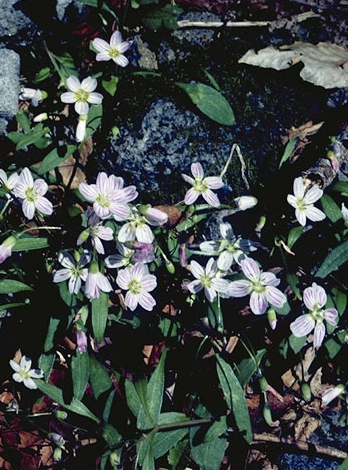
     On the ground I am also looking for something.  Once the red maples begin to bloom, I look for the yellow trout lilies and the pink spring beauty to bloom.  They complete my definition of the beginning of spring.  By the time they begin to bloom the spring peepers are kicking up a fuss in the local ephemeral ponds looking for mates.  Their eggs will hatch in the spring and by early summer the tadpoles will have become frogs and be already to venture out of the pond.   
     Spring might be an exciting time defined by wonderful showy blooms in the garden, but to really know that the season is here you need to go out into the woods.  Let the native plants show you the way!